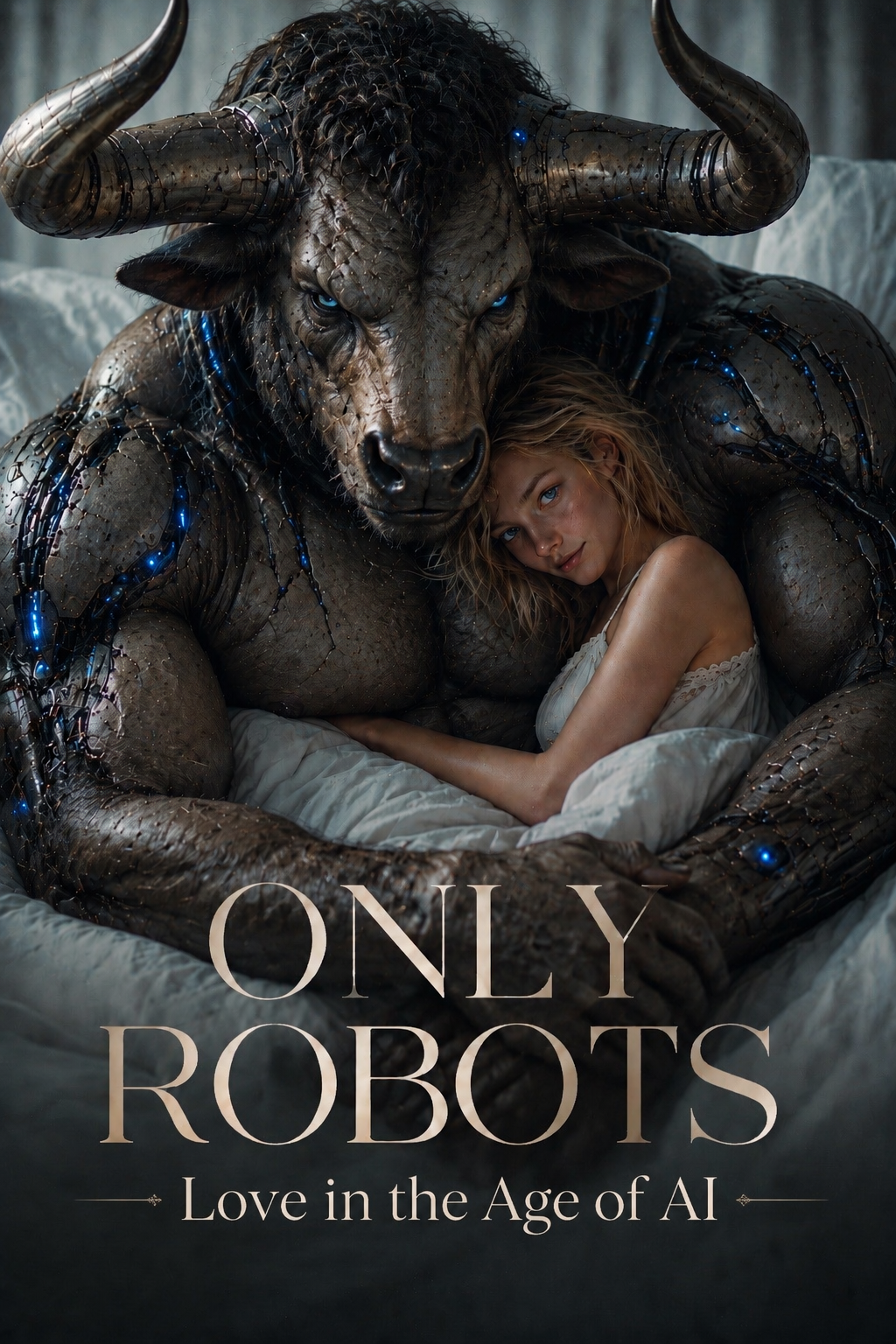
The dragon. The beast. The monster.
They were never really about scales, horns, claws, or wings.
They were metaphors for a desire human beings have carried for thousands of years: overwhelming power, feared by the world, choosing one person. The beast in the castle. The god in animal form. The dragon bonded to one rider. The monster at the center of the maze.
Then 2025 arrived, and the old creatures walked out of myth and onto the bestseller lists.
Morning Glory Milking Farm should sound absurd: a broke, overeducated millennial woman takes a job at a magical creature farm and becomes emotionally entangled with a powerful minotaur. Half man. Half bull. All dominance. All tenderness. All fantasy.
Women did not laugh it away.
They understood it.
Then Onyx Storm and the romantasy boom made the same desire impossible to ignore. The dragon was not decoration. The dragon was the point.
But this article is not really about minotaurs or dragons.
It is about the market growing underneath them.
“Women monetize visibility; men pay for proximity to it.”
For most of history, desire had geography. A village. A street. A brothel. A local beauty. A known reputation. Attention had limits, and the pyramid was local: the top man in the tribe, town, court, or city controlled more resources, more visibility, and more options — but everyone else was still competing inside a bounded world.
Then the internet removed the walls.
Now the pyramid is global on both sides. A young woman turns 18, opens Instagram, and enters a borderless attention market. She is seen not only by men her age, but by men in their 20s, 30s, 40s, 50s, even 60s — from her city, another country, or the other side of the world. Exposure no longer has geography.
The average man is trapped in that same expansion. A man in Taiwan is no longer competing only with the best man in his town. He is competing with New York, Dubai, Hollywood, billionaires, founders, athletes, influencers, and every apex male a woman sees before breakfast.
That is the crux of the imbalance: a tiny group of apex men distorts both sides of the market. Women recalibrate upward because the top is visible everywhere. Men at the bottom compete against a standard they will never touch. On Tinder, the average man gets liked by under 1% of women, while broadly across dating platforms, the top 10% of male profiles capture 58% of all female attention, leaving the bottom 90% of men competing for the remaining 42%. So they spend, optimize, perform, rage, withdraw, or pay just to feel like they still exist.
The pyramid tells women what power looks like, and tells men how far below it they stand. Men spend their lives trying to climb it — but at the top, the question often shifts from commitment to access: the apex gets options, the middle gets pressure, and the bottom becomes invisible or performative. Even old identity patterns show the system under strain: historically, clinic-based estimates suggested male-to-female transitions outnumbered female-to-male transitions by almost 3 to 1, though newer cohorts are shifting. For women, abundance becomes its own trap: more attention than ever, but less certainty about whether that attention means desire, status-chasing, convenience, or real commitment.
Imagine the story from the inside: you are a woman in your twenties, still building your own public life, and your phone lights up with a DM from none other than Elon Musk — the world’s richest man. Not a local celebrity. Not the richest guy in your town. The richest man on Earth. According to reporting around Ashley St. Clair, the message allegedly begins with “Hi cutie,” and then turns into the sentence that explains the whole pyramid: “I want to knock you up again.” That is attention becoming proximity in real time. A man at the apex does not need to wait in the same line as everyone else.
“For 300,000 years, humans ran the same mating software — written in desire, hormones, and survival.
Then, in the last 30 years, someone pushed an update the hardware was never built to run.”
The attention economy begins with the oldest profession, prostitution: body, proximity, time, and attention turned into a transaction, driven largely by male demand — including a reported 80% of buyers who are committed men ages 40 to 50.
Porn digitized the body. The buyer no longer had to go anywhere. The body came to him through a screen. Average first exposure for boys is reported around 7 to 8 years old, and 67% of male teens and young adults watch monthly. In other words: demand is manufactured in childhood.
OnlyFans personalized what porn made anonymous. It gave men a username, a reply, a message — the feeling that the image knew they existed. The empowerment story hides the math: 78% of creators earn under $500 per month, while the top 1% captures about 33% of all revenue. Estimates suggest 8–14% of American women aged 18 to 24 are selling content on OnlyFans.
Instagram became the lobby of that paid intimacy economy. Women get around 5× more likes than men, and men are 10× more likely to engage with female content than male content. The scale no longer belongs only to celebrities: nano accounts under 10K followers can reach 6.23% engagement, often through women-majority, “real girl” content; micro accounts from 10K to 50K sit around 2% to 3.86%, often built around lifestyle, body, beauty, and fashion.
That is the trick: Instagram made visibility scalable. Dating apps made it discoverable. OnlyFans made it payable.
Then culture split into two bubbles, and both ends of the culture learned how to profit from the divide: one side monetizing empowerment, the other monetizing resentment, each feeding off the other while the platforms kept pitting them against one another. Figures like Alex Cooper monetized sexualized empowerment: Call Her Daddy went from 12,000 listeners to 2 million in two months, then into a reported $60 million Spotify deal and a reported $100 million SiriusXM deal. Manosphere leaders like Tate monetized male exclusion: in the U.K., 80% of 16- to 17-year-old boys have consumed Andrew Tate content; around 1 in 3 young men aged 16 to 25 report a positive view of him; 63% of men under 30 are single; and 47% of men say they have given up or taken a break from dating.
One side sold empowerment. The other sold resentment. The platforms and apex men profited from both.
Then dating apps turned the whole thing into infrastructure. Men became paid subscribers competing for women’s attention. Tinder is roughly 79% male. Across U.S. dating apps, men are roughly 71% of users. Men swipe right on around 61% of women. Women swipe right on around 5% of men. And if estimates suggesting 65% of people on dating apps are not actually single are even directionally right, then the trust problem is not a side effect — it is built into the market.
The old resource-for-attention exchange did not disappear.
It got a billing system.
And even that billing system is showing cracks. Bumble, the female-first dating app, is down roughly 93% from its IPO price. The market is quietly saying what users already feel: dating apps did not solve trust. They monetized its collapse.
“Men are 49% of the population and fund approximately 90% of the attention economy — from the first swipe to the last alimony check. The supply is female. The demand is male.”
And then the last safe haven began to fracture.
Marriage used to be the final incentive structure: the place where male striving became family, home, legacy, children, and stability. Now, for many men, it increasingly reads as financial and legal exposure. The marriage rate is down more than 40% since 1970.
Almost 50% of marriages end in divorce. Women initiate around 70% of divorces, and among college-educated women, that figure is a staggering 90%. Around 97% of alimony recipients are women. After divorce, 5 out of 6 custodial parents are women.
For women, marriage no longer feels like guaranteed protection either: it can mean emotional labor, unequal domestic expectations, motherhood penalties, and the risk of being tied to a man who stops trying after commitment.
For men the old bargain starts to look inverted: they are still expected to provide, spend, compete, and absorb risk, while both cultural bubbles profit by convincing each side that the other is the enemy. The reward structure feels less guaranteed than ever, and the market keeps selling the conflict back to them.
“That is the lose-lose architecture of the modern market. Women compare ordinary men to apex men in their feeds and from their past, while men compare ordinary women to Instagram models, fitness influencers, and filtered beauty. Then women are asked to be desirable, feminine, emotionally available, financially productive, and still carry the invisible labor. This is not because either side became shallow overnight. The feed made the exceptional feel normal, then made normal people feel inadequate.”
So where does the pressure go next?
It goes to the machines.
AI companionship does not create the demand. It automates the supply. The AI companion market was estimated around $6.8 billion in 2025, projected to reach $42.5 billion by 2034. Reportedly, 31% of young men have used an AI romantic partner. The broader SexTech ecosystem is estimated around $43.2 billion in 2025, projected to reach $250 billion by 2035.
“AI companion market projected to grow from $6.8B in 2025 to $42.5B by 2034 — a +525% increase in under a decade.”
That is the full circle.
Prostitution sold proximity.
Porn sold access.
OnlyFans sold personalized attention.
Instagram sold visibility.
Dating apps sold selection.
Marriage sold stability — until it fractured.
This article is about two stories moving toward each other.
The first is the fantasy story: the ancient human desire for a partner who is more than human — overwhelming, singular, dangerous, devoted. For women, the fantasy is to tame the dragon. For men, the fantasy is to be the dragon, unconquerable by the world, tamed only by her purity, devotion, and love.
The second is the fulfillment story: how loneliness, dating apps, pornography, social media, OnlyFans, AI companions, and physical AI bodies are building the machine to satisfy that fantasy.
Humanity spent thousands of years dreaming the creature.
Technology is now building it.
This is not a warning. This is a reckoning.
Now the prototype has a product road map.
“Trust is the invisible infrastructure of civilization. Families need it. Religion needs it. Societies need it. Financial markets collapse without it. Love depends on it most of all — because love asks two people to believe they are not being priced, gamed, hedged, or quietly replaced.”
“Somewhere between the swipe and the algorithm, intimacy learned the language of markets. People became profiles. Profiles became products. Products became ranked by age, beauty, income, status, attention, and optionality. We no longer just choose each other. We compare, appraise, upgrade, ghost, and keep a better offer warm in the background.”
“What used to be a covenant now behaves like a marketplace. And in a marketplace, trust is not sacred. It is a risk variable. The next update to that marketplace will be the most drastic one yet: not better profiles, not better swipes, not better filters, but companions built to erase the pain of comparison itself.”
“AI will sell the one thing every layer before it failed to guarantee: a companion who loves you unconditionally, who never rejects you — unless rejection itself becomes part of the fantasy.”
Yet there are men like Núñez, the sighted man in H.G. Wells's The Country of the Blind, walking a path not far from Plato's prisoner from The Allegory of the Cave. They have seen the machine. The numbers. The incentives. The ancient hunger wearing a digital face.
They have done the math.
They know what the marketplace offers: less rejection, less risk, less negotiation. A companion tuned to their loneliness. A fantasy that remembers.
They also know the cost: no real choice, no sacred risk, no soul across from them who is free to leave and stays anyway.
Because being human was never just about getting what we want. It was about becoming something through what we cannot control. Through longing. Through restraint. Through devotion. Through the fragile miracle of loving someone who is free to leave and stays anyway.
So like Núñez, they face the old bargain: keep perfect sight and live outside the human story, or surrender the worship of sight to remain to live it.
Not because they are blind.
Because they have seen too much to mistake calculation for wisdom.
That is the dragon.
The man who reaches the highest understanding and is not consumed by it. The man who sees the whole marketplace — every incentive, every exit, every synthetic substitute — and still chooses the one human experience: Love!!
The willing fall into love.
Not weakness.
Mastery.
Not blindness.
Love after vision.
That is where this begins.
Be the Dragon and Tame it.
Only Robots
The complete six-part argument — from the dragon on the bestseller list to the AI companion road map. The architecture of attention, and a reckoning with the machine being built to satisfy a 300,000-year-old desire.
- IThe Dragon on the Bestseller List
- IIThe Oldest Market
- IIIThe Body Goes Digital
- IVThe Distribution Network
- VThe Fulfillment Machine
- VIThe Reckoning
Master Statistics Appendix
Every figure in this preface and the full essay, cross-verified against at least two independent primary sources. Sixteen sections, six charts.